
Table of Contents
Where online businesses leak money
Most online businesses don't lose money in big, dramatic ways. They lose it in small, steady leaks.
A subscriber’s card is no longer valid. Insufficient funds, a replaced card, a closed account. They’re only notified after the attempt fails. If they don’t take action in time, the subscription cancels entirely, and the customer has to go back through checkout to start again.
A buyer starts filling out the checkout form and then disappears. Until now, abandoned checkout emails only reached existing customers. New potential buyers, the ones most likely to need a nudge, fell through the gap entirely. And even when emails did go out, there was no way to know which offers had the highest abandonment rates or which messages were actually bringing people back.
A buyer reaches your checkout and the labels feel generic, off-brand, nothing like the rest of your business. The tone that got them this far disappears right at the moment it matters most.
Or your revenue sits in payout transit for two days when you need it in minutes. A vendor invoice due today. Payroll that can’t stretch. Critical business actions that shouldn’t have to wait on a processing schedule.
Each of these is a small leak. Fifty dollars here. A subscription there. A bounced checkout that would have been recovered with a smarter follow-up. Revenue sitting in payout transit for two days when you need it in minutes to fund something that can’t wait.
Over the course of a year, these leaks add up to real money. Across the lifecycle of an online business, they add up to a lot of customers who could have stayed and a lot of revenue that didn't have to leave.
This cycle, we shipped six updates in Kajabi Commerce that close those leaks. Each is small on its own. Together, they protect a meaningful percentage of revenue that most experts are quietly losing without knowing it.
Why small checkout problems compound
Most e-commerce tools were built for the happy path. The customer arrives with intent, fills out the form, the card works, the platform charges, the receipt is sent, and everyone moves on.
The unhappy path gets less attention. Recovery is a checkbox. Customization is bolted on. Payouts are whatever the underlying processor sets as default. The result is software that works beautifully when nothing goes wrong and quietly costs you money when something does.
For online businesses, the unhappy path matters more than people realize. A 2% drop in checkout completion across a year is real money. A 5% improvement in failed payment recovery is meaningful retention. Two business days of faster payouts is the difference between making payroll and stretching it.
When the platform doesn't take the unhappy path seriously, three things happen.
First, you build workarounds. You try to capture potential customer emails via your form, since you can’t reach them through an abandoned checkout email. You manually message subscribers whose cards declined. You try writing custom code to override the labels in your checkout to make it sound more like your brand instead of a generic platform.The platform's gaps become your work.
Second, you stop paying attention to the revenue you can’t see. Lost checkouts become invisible. Potential customers who bounce never show up in any dashboard. Failed payments become noise. The leaks continue because no one is measuring or automating recovery.
Third, your time goes to commerce operations rather than to the actual business. Hours that should be spent on creating content, courses, and community get spent chasing failed payments and building custom flows that the platform should have available.
This cycle's commerce updates are an attempt to take the unhappy path seriously. The features look small. The leaks they close add up to real money.
What we believe commerce should do
Commerce is where intent becomes revenue.
Every bit of friction on that path is a tax on your business. Some of it is unavoidable. Most of it is. Cards fail, and customers bounce no matter what platform you're on. The platform's job is to make recovery easy, customization deep, and funding fast. Anything less is leaving money on the table.
We think the commerce layer of an expert business platform should do four things well:
- Capture revenue cleanly when intent is highest, with payment options that match the transaction
- Recover revenue patiently when something goes wrong, with the right nudges at the right times
- Customize the experience for the actual audience the business serves
- Move the money fast when you need it, so cash flow matches the rhythm of the business
This cycle's six commerce updates each map to one of those jobs. Together, they make the unhappy path of online commerce shorter, the recovery rate higher, and the cash flow faster.
What's new in Kajabi Commerce
Six commerce updates shipped this cycle. Three of them protect revenue you might be losing today. Two of them help you bring revenue in faster. One gives you control over a real edge case that has cost experts in the past.
Upcoming Payment Reminders
.png)
For subscriptions and payment plans, the most preventable revenue loss is a card you didn't know was about to fail. Customers don’t always realize that their card is no longer valid or they don’t have funds available. The first sign you have is a failed payment, by which point the customer might already be gone.
Upcoming Payment Reminders give your customers a heads-up before they're charged. A short, friendly email sent ahead of the renewal, at a time you choose. If the card on file has an issue, they have time to update it. If everything is fine, they have advance notice that the charge is coming.
The result is fewer failed payments, less involuntary churn, and a small but compounding lift in retention.
Improved Abandoned Checkout Emails
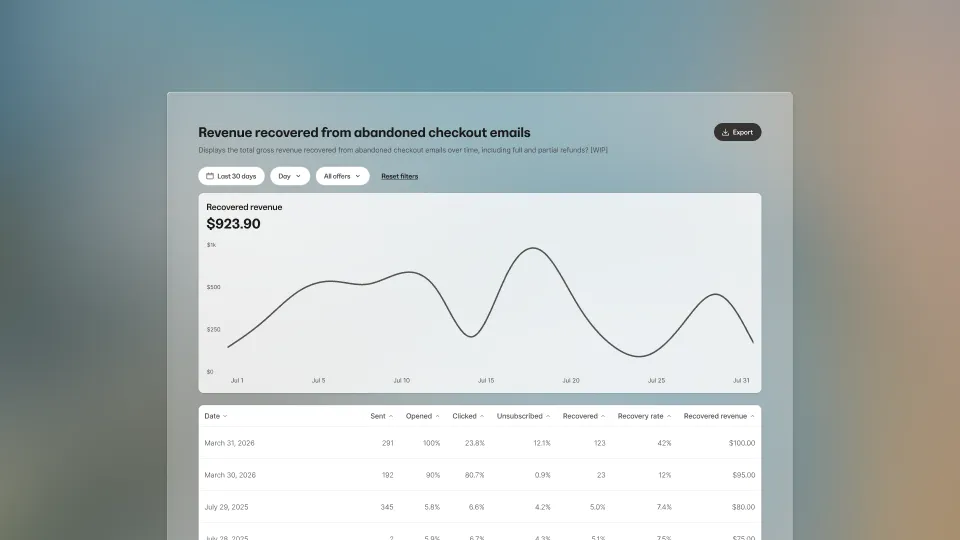
Until now, abandoned checkout emails in Kajabi only reached existing customers. Anyone who started the checkout form without an account, a potential new buyer who got close but didn’t complete, fell through entirely. The improvement changes that. Now, anyone who enters an email address and begins checkout will receive an abandoned checkout email, giving you far wider coverage and a much better chance of recovering revenue that would otherwise be gone.
This turns abandoned checkout from a fire-and-forget feature into a real recovery tool with measurable lift.
Instant Payouts
Most businesses run on a standard payout schedule. That works fine until it doesn’t. A vendor invoice due today. Marketing spend that needs to go out now. Payroll that can’t wait for the next cycle.
Instant Payouts on Kajabi Payments give you access to your funds within minutes, not days. When something can’t wait for your regular payout schedule, you don’t have to. The option is there when you need it, and out of the way when you don’t.
This is rolling out in beta first, with eligible Heroes invited to opt in.
Invoice Payment via ACH Bank Transfer
For larger transactions, ACH Direct Debit is the payment method most US-based businesses prefer. Lower processing fees, familiar from any business banking interface, and reliable for high-value invoices.
Kajabi Invoices now support ACH Direct Debit as a payment method. This is particularly well suited to the kinds of transactions invoices are built for: custom pricing, coaching engagements, consulting retainers, and any high-value work where you’re sending a client an invoice rather than routing them through a checkout page. Your customers see a familiar payment option. You keep more of every transaction because ACH fees are a fraction of card fees.
Checkout Label Overrides
Your checkout is the last step before a buyer becomes a customer. But for most platforms, that page sounds like the platform, not like you. Generic labels, standard button text, error messages that could belong to anyone.
Checkout Label Overrides let you customize the wording on your checkout page to match the tone and voice of your business. Swap out default labels, rewrite button text, personalize the experience so that the momentum you built getting someone to checkout doesn’t evaporate the moment they arrive.
It’s a small change with a direct impact on conversion. The words on your checkout page should sound like you wrote them.
Options When Removing a Product From an Offer
.png)
The last update is the kind of thing that matters more than it sounds.
Previously, when you removed a product from an offer in Kajabi, the platform did nothing for existing customers, creating a gap. There was no clean way to bulk-revoke access for existing members, and experts ended up resorting to risky workarounds when they really wanted to cut access.
Now, when you remove a product from an offer, a confirmation modal presents two explicit options:
- Keep access for existing offer members. Existing purchasers retain access. Only future buyers won't receive the product.
- Remove access for existing offer members. All existing purchasers immediately lose access.
Both are first-class options. Both are clear about what they do. Both prevent the surprise revocations or zombie access experts have hit in the past.
Who these updates are built for
Different experts will get different value from this set. A few scenarios where the changes matter most.
Subscription and membership businesses. If your business runs on recurring revenue, Upcoming Payment Reminders and Improved Abandoned Checkout Emails are the two updates that compound fastest. Every failed payment caught early is recurring revenue saved. Every abandoned cart recovered is a customer who was about to slip and didn't.
Service-based experts using invoices. Coaches, consultants, agencies, and anyone billing for high-value engagements. ACH on invoices means lower fees on the largest transactions in your business. Over a year of contracts, those fees add up to a meaningful margin.
Brand-conscious experts. Experts who care about brand consistency all the way through the buying experience. Checkout Label Overrides let you bring your tone and voice into the final step of the purchase, so your checkout feels like an extension of your brand, not a handoff to a generic platform.
High-volume sellers with cash-flow needs. If your business generates enough revenue for two-day payout delays to affect operations, Instant Payouts is the most concrete cash-flow upgrade on the platform. Pay vendors faster. Fund inventory faster. Match the rhythm of money to the rhythm of your business.
Experts iterating on offers. Anyone who runs versioned products, beta cohorts, or evolving offer mixes. Options When Removing a Product turns a previously risky operation into a clean one. Move products in and out without orphaning customers or accidentally pulling access from people who paid.
If you're running any of these business shapes, this set of updates is for you.
How to start protecting your revenue today
All six updates are rolling out across Kajabi Commerce. The fastest way to put them to work:
- Open Payment Settings and check whether Instant Payouts is available for your account.
- Turn on Upcoming Payment Reminders for your subscription and payment plan offers.
- Audit your abandoned checkout emails. Reporting now shows which products are losing the most carts. Pick the one with the biggest leak and write a better recovery sequence.
- If you have international audiences, customize checkout labels for at least one non-English language.
- The next time you remove a product from an offer, look for the new "Keep access" or "Remove access" choice. Pick the one that matches your intent.
Spend an hour inside Kajabi Commerce after reading this. Most of these updates are worth more than the time it takes to enable them.
The bigger picture: commerce is where intent meets revenue. The platform's job is to clear the path from one to the other. This cycle's six updates close real leaks that have cost experts real money. Future cycles will keep closing more.